 title="Visit our linkedin profile"]
 title="Visit our Bluesky profile"]
 title="Visit our Instagram profile"]
 title="Visit our TikTok profile"]
Most Scottish councils disadvantage children in co-parenting arrangements in their Assistance with Travel to School policies
“One address only” practice rations assistance to eligible children by making one parent invisible
“We drive behind the school bus that has picked up her classmates but which she is barred from.”
Assistance with Travel to School schemes are devolved to local authorities within general Scottish Government guidelines. The educational premise within the Assistance with Travel to School concept is that it should assist children to arrive fit and ready for learning.
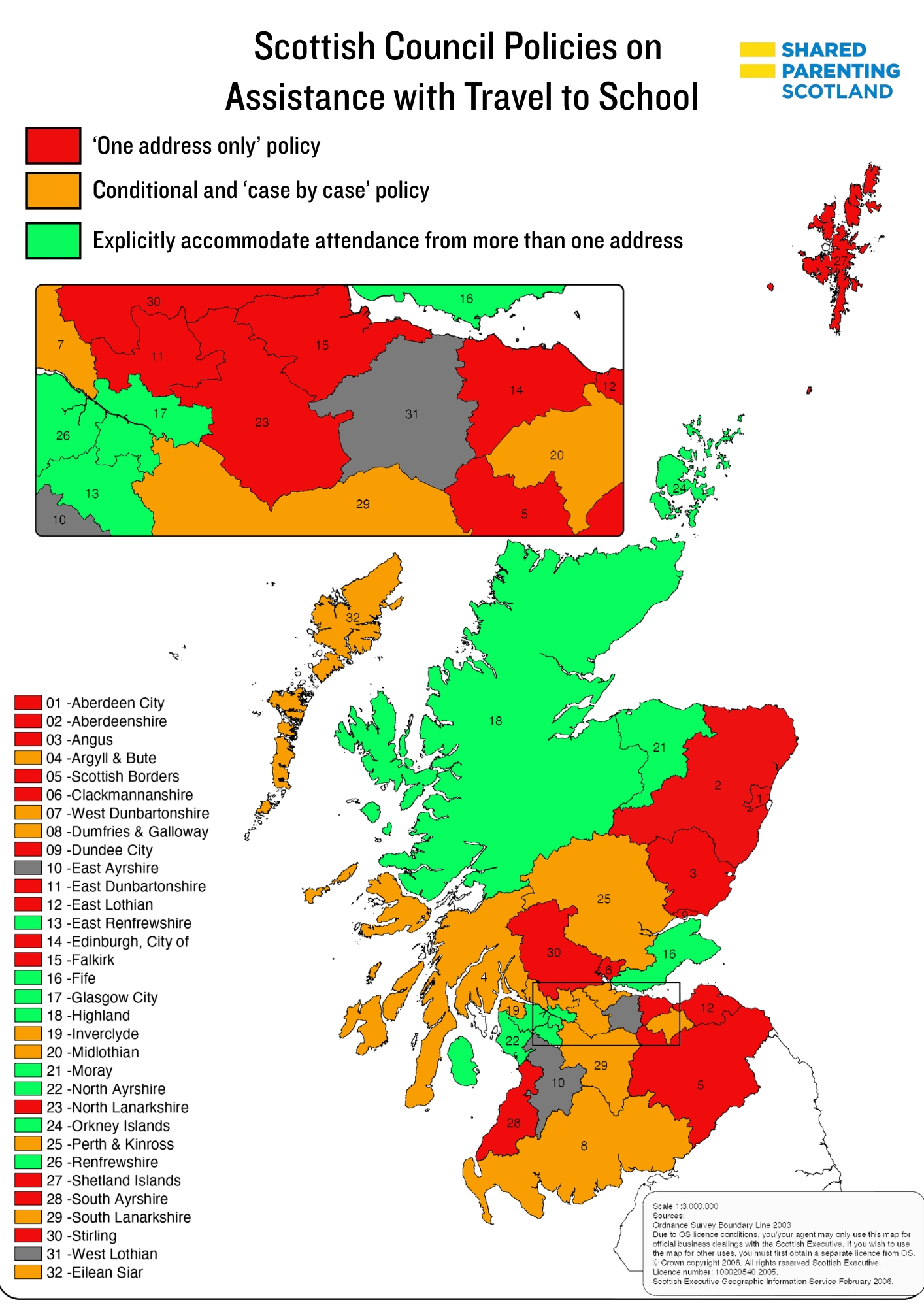
Yet Freedom of Information enquiries by Shared Parenting Scotland in autumn 2025 revealed that more than half of Scotland’s local authorities refuse access to their assistance with travel scheme when a child starts their journey from one of their parent’s home, or impose conditions that not all co-parents can meet.
Fifteen councils operate an explicit “one address only” policy. That ignores the reality of life for many children who travel to school from more than one address when their parents do not live together. Even in situations where a child spends equal time with each parent these councils disregard the existence of one of them.
Seven further councils have “discretionary” policies or impose restrictive criteria for accepting two addresses such as evidence of a court order. Scottish Government preference is for separating parents to reach their own agreements rather fight in court. Many co-parents who heed that advice will never have a court order.
Only eight councils – Moray, Orkney, East Renfrewshire, North Ayrshire, Renfrewshire, Glasgow, Highland, and Fife have a policy that explicitly accommodates shared parenting within their general eligibility criteria.
Councils variously base eligibility on their own decision as to “the main parent” such as “the address where Child Benefit is paid” or “the address of the parent who enrolled the child”, and not on the individual needs of the child.
The Scottish Government estimates that a third of the school roll have parents who do not live together. Not all live across two homes but those who do can find the school bureaucracy struggles with the idea of co-parenting.
The Scottish Schools (Parental Involvement) Act 2006 sets out that schools should engage with both parents to support their children’s learning. The accompanying guidance urges schools to work hard to involve non-resident parents in particular and fathers in general.
The UNCRC (Incorporation) (Scotland) Act 2024 requires public bodies including local authorities to apply a children’s rights perspective to all policies and decision making. The Shared Parenting Scotland FOI requests last autumn revealed no councils have so far reviewed their Assistance with Travel to School policy in terms of UNCRC incorporation.
One father in Shared Parenting Scotland’s case work said, “The Council says my child can use a series of buses but relying on them all arriving according to timetable is wishful thinking. To make sure he isn’t late for school we start at a crazy time in the morning. It’s hard on him.”
Another said, “We are in the ridiculous position that when she is with me on a school day, we drive behind the school bus that has picked up her classmates but which she is barred from.”
Shared Parenting Scotland Chief Executive, Kevin Kane, says, “The Assistance with Travel to School Guidelines are out of date and out of touch with lives of the children they were designed to help.
They not only make travel to school unnecessarily hard for children who live some time with each parent but can also corrode the stability of a co-parenting arrangement. What teenager would rather get up at 6.30 to get to school when they don’t get assistance with travel from one parent’s address when they could stay in bed another hour from the other’s?
This is one of the ‘embedded disincentives to shared parenting’ we are calling on the next Scottish Parliament to deal with.
We know that some councils say they can make discretionary or “privilege” decisions on certain applications but that is not a substitute for a transparent, rights-based system for all children.
If some councils have scrapped their restrictive policies since our FOIs we’ll be delighted to give credit to them.”
Notes
The “one address only” responses to the Shared Parenting Scotland FOI requests are:
Aberdeen City, Aberdeenshire, Angus, City of Edinburgh, Clackmannanshire*, Dundee City*, Stirling, East Dumbartonshire, East Lothian, Falkirk, Midlothian, North Lanarkshire, South Ayrshire, Scottish Borders and Shetland Islands.
* Clackmannanshire allows parents who wish their child to attend from more than one address they may apply for a ‘privilege pass’ which is allocated when there are unused seats on buses.
**Dundee City policy allows for flexibility specifically for children attending Kingspark ASN school.
The councils whose policies explicitly accommodate attendance from more than one address are:
East Renfrewshire, Fife, Glasgow, Highland, Moray, North Ayrshire, Orkney, Renfrewshire
The councils with conditions and ‘case by case’ policies are:
Argyll and Bute, Dumfries and Galloway, Inverclyde, Western Isles, Perth and Kinross, South Lanarkshire, Midlothian, West Dunbartonshire
Two councils – West Lothian and East Ayrshire did not reply.